
Critique 309 – Alcohol-attributable cancer mortality in the United States, 1990–2023: a secondary analysis of Global Burden of Disease data
Jani, C.T., Edwards, K., Sharma, R., Jani, R.T., Sbihi, A.A. Noy, J., Chedid, G., Kareff, S., Shalhoub, J., Salciccioli, J., Watson, D.C., Chauhan, A., Rodriguez, E., Lopesa, G.
The Lancet Regional Health – Americas (2026) 101599, in press
https://doi.org/10.1016/j.lana.2026.101599
Abstract
Background: Alcohol consumption is known to be a significant risk factor for cancer. In 2025, the US Surgeon General recommended adding cancer risk warning labels to alcoholic beverages, emphasizing the need for increased awareness. However, national-level data describing long-term trends in alcohol-attributable cancer mortality, including variation by age, sex, and geographic region, remain limited. This study aims to evaluate trends in alcohol-attributable cancer mortality in the USA.
Methods: This was a population-based observational trend analysis using data from the Global Burden of Disease database. We analysed age-standardized mortality rates (ASMRs) and the percentage of ASMR attributable to heavy alcohol use–defined as consumption exceeding the theoretical minimum risk exposure level, in the USA from 1990 to 2023. We evaluated ASMR for all cancers combined, followed by ten specific cancers. Results (per 100,000 population) were stratified by sex, location (50 states and Washington DC), and age-groups (20–54, 55 years and older). Joinpoint regression was performed using Monte Carlo permutation testing to select the optimal model; EAPCs were reported with 95% confidence intervals and two-sided p values. All rates are reported per 100,000 population.
Results: Alcohol-attributable cancer deaths in the USA doubled from 1990 (11,361) to 2023 (23,126). Mortality rates were higher in the 55 years and older age-group (19.2; 95% CI, 12.8–28.7) versus 20–54 years (2.4; 1.4–3.4), and in males (6.4; 3.8–9.7) versus females (2.1; 1.4–3.0). The percentage of mortality attributable to alcohol increased across most cancer types, age groups, and sexes, with liver cancer demonstrating the greatest increase in alcohol attributable (113.9%). In 2023, liver (12.7; 11.2–14.4) and breast (2.4; 0.9–5.9) cancers had the highest alcohol related mortality rates in 55 years and older males and females, respectively; in ages 20–54, colorectal (0.9; 0.4–1.4) in males and breast (0.9; 0.5–1.4) in females were highest. State-wise, the District of Columbia recorded the highest (M: 9.8; 6.0–14.1; F: 3.5; 2.2–5.2), while Utah had the lowest (M: 3.9; 2.4–5.9; F: 1.4; 0.9–2.0) ASMR.
Interpretation: Alcohol-attributable cancer mortality has increased in the USA, with a disproportionate burden observed in males and 55 years and older individuals. Our findings highlight the critical need for targeted prevention efforts and increased awareness to address the rising impact of alcohol consumption on cancer-related mortality.
ISFAR Summary
Jani et al. (2026) in The Lancet aimed to analyse alcohol-attributable cancer deaths across cancer types in the USA from 1990 to 2023 using Global Burden of Disease (GBD) data. Specifically, the authors intended to evaluate trends in national-level alcohol-attributable cancer mortality.
The authors report a substantial increase in the absolute number of alcohol-attributable cancer deaths. However, the US population increased by approximately 35% between 1990 and 2023, which would be expected to contribute to an increase in the absolute number of deaths. Age-standardised mortality rates, which correct for changes in age distribution, are reported to increase from 3.8 to 4.1 per 100,000, a much smaller increase than the near doubling in absolute deaths.
An important limitation is the incompleteness of exposure data, since current cancer mortality may reflect cumulative alcohol exposure from many years or decades earlier. Also, ‘exposure to alcohol’ does not take into account important factors such as beverage type, dietary background and drinking pattern.
An important statistical concern is the large number of comparisons across cancer sites, age groups, sexes, states, and time periods. In addition, the description of outcome parameters changes across the various sections of the paper, reducing transparency. The paper also alternates between “confidence intervals” and “uncertainty intervals,” which are not interchangeable and should be distinguished consistently.
Jani et al.’s (2026) data on alcohol-attributable cancer deaths are surprising, given that overall cancer deaths have continued to decline in the USA over the past several decades. The authors estimate that alcohol-attributable cancer deaths in the USA doubled from 1990 to 2023. However, risk factor-attributable cancer mortality is estimated for 88 different risk factors. As a result, the proportion of alcohol-attributable cancer deaths may simply rise when cancer deaths attributable to other risk factors, such as smoking, decline.
In conclusion, this paper by Jani et al. (2026) may be somewhat misleading, since the relationship between their findings and other data, such as actual alcohol consumption, overall cancer death trends and population growth, is unclear. Also, proportional attributions cannot be evaluated independently of other risk factors that have changed over such a long period.
Background
Alcohol consumption and its association with cancer incidence and mortality have been extensively studied and are therefore regularly discussed in our critiques. The International Agency for Research on Cancer (IARC) registered alcohol consumption as a Class 1 carcinogen (International Agency for Research on Cancer, 2012), meaning that IARC considers there to be sufficient, convincing evidence from scientific studies, primarily epidemiological research involving exposed populations, showing that the agent causes cancer in humans. Well over 130 substances have been classified in this Class 1 category, including tobacco smoking and processed meat.[1].
IARC classifies alcohol consumption (and its ethanol metabolite, acetaldehyde) as a Class 1 carcinogen for at least seven specific cancers, namely cancers of the breast, colon and rectum, liver, mouth, throat, voice box and oesophagus. For the remaining approximately 200 cancer types (Song et al., 2015), no clear positive association has been established. In some cases, a negative association has been reported between alcohol consumption and cancer incidence (Fehringer et al., 2017). Whereas the seven Class 1 alcohol-attributable cancers include two of the most common cancers (breast and colon/rectum), other cancers are less common.
Some studies have indicated that even at low to moderate drinking levels, the risk of certain cancers is increased (Bagnardi et al., 2013). Other, more recent studies (National Academies of Sciences, Engineering, 2025) have indicated that moderate drinking, compared with never drinking, is associated with breast cancer incidence with moderate certainty. This extensive study also concluded that no conclusion could be drawn about the association between moderate alcohol consumption and the risk of colorectal cancer compared with lifetime non-consumers. Similarly, no conclusion could be drawn about an association between moderate alcohol consumption and cancers of the oral cavity, pharynx, oesophagus, or larynx.
Some are convinced that alcohol consumption may cause cancer in various ways, namely through DNA damage, oxidative stress, hormonal changes and alterations in the gut microbiome[2]. However, some methodological issues may confound the association, particularly among light and moderate drinkers. For instance, an association between alcohol consumption and smoking is consistently observed across many populations. Because alcohol consumption and smoking are correlated behaviours and smoking is a strong risk factor for cancer at many sites, residual confounding by smoking is a concern when estimating the risk attributable to alcohol alone. Interactions between alcohol consumption and other cancer risk factors are likely weaker but may still be relevant to the effect of alcohol on carcinogenesis. Unaddressed interactions could alter our understanding of how alcohol consumption affects cancer risk (Gapstur et al., 2022). Interactions between risk factors may also differ across cancer subtypes. For example, there is evidence that alcohol is associated with oestrogen receptor-positive but not oestrogen receptor-negative breast cancer (Jiang et al., 2024). Alcohol consumption is associated with breast cancer incidence but may not be with breast cancer recurrence incidence (Arecco et al., 2026).
The aim of the study by Jani et al. (2026) in The Lancet is to analyse alcohol-attributable cancer deaths across cancer types in the USA from 1990 to 2023 using Global Burden of Disease (GBD) data, with the main intention of increasing awareness that alcohol is a significant risk factor for cancer. Specifically, the authors intended to evaluate trends in national-level alcohol-attributable cancer mortality in the USA, stratified by sex, location and age group.
Critique
Jani et al. (2026) use various types of data from the GBD database, namely total alcohol-attributable cancer deaths, age-standardised mortality rates, age-standardised-specific mortality rates (ASMRs), age-group-specific mortality rates, and the percentage of mortality attributable to alcohol for all cancers combined and by ten individual cancer types, at both national and state levels. Although the authors describe several alcohol-attributable cancer-death-related parameters derived from multiple data sources and extensive modelling, none of these data was correlated with alcohol consumption in the same groups (age groups, US states) over time. The incompleteness of exposure data has been acknowledged as an important limitation of this study, but an initial attempt to evaluate the relation between alcohol consumption over time and/or alcohol consumption differences between states and their associations with alcohol-attributable cancer deaths would have strengthened the data and the conclusions drawn. Importantly, such an analysis would also need to account for the prolonged latency of many alcohol-related cancers. Current cancer mortality may reflect cumulative alcohol exposure from many years or decades earlier, rather than alcohol consumption in the same year. Jani et al. (2026) acknowledge this prolonged latency, but their analysis does not examine lagged or cumulative alcohol exposure when interpreting temporal changes in alcohol-attributable cancer mortality.
Interestingly, the authors did not use actual alcohol consumption for relative risk assessment; instead, they used the Theoretical Minimum Risk Exposure Level (TMREL). TMRELs were assessed individually for each region, age, sex, and year by identifying the consumption level that minimised overall health loss. However, no information was provided on the superiority of this approach over the classical risk association between actual alcohol consumption and cancer deaths over time. Also, the authors set relative risk to 1 not only for abstainers but also for those below TMREL, thereby filtering out any potential beneficial effect from the analysis.
The first result reported that, between 1990 and 2023, alcohol-attributable cancer deaths in the USA doubled, rising from 11,361 (ASMR: 3.8/100,000; 95% CI: 1.7–6.9) to 23,126 (ASMR: 4.1/100,000; 2.7–5.8). The significance of this finding is unclear, since the percentage increase in estimated deaths is about 100%, whereas the ASMR increases by about 8% and the confidence intervals for ASMR in 1990 and 2023 overlap. Moreover, the substantial increase in the absolute number of alcohol-attributable cancer deaths should be distinguished from changes in age-standardised mortality rates. The US population increased by approximately 35% between 1990 and 2023, which would be expected to contribute to an increase in the absolute number of deaths. However, age-standardised mortality rates account for differences in population size and age structure. Jani et al. (2026) report an increase in the ASMR from 3.8 to 4.1 per 100,000 over the study period, a much smaller increase than the near doubling in absolute deaths. The reasons for this increase in the age-standardised rate, therefore, require separate consideration and cannot be attributed solely to population growth.
Jani et al.’s (2026) data on alcohol-attributable cancer deaths are also surprising, given that overall cancer deaths have continued to decline in the USA over the past several decades (Siegel et al., 2026) as shown in the figure below. However, the authors attribute the decline in overall cancer incidence and mortality to reduced tobacco use, earlier detection and better treatment.
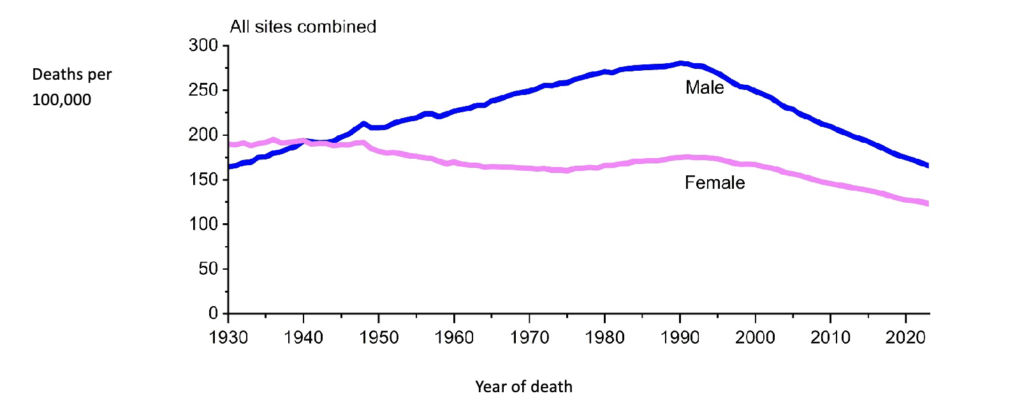
Alcohol-attributable disease burden and mortality are estimated for 88 risk factors using population attributable fractions (PAFs) and TMRELs. As a result, the proportion of alcohol-attributable cancer deaths may simply rise when cancer deaths related to other risk factors decline. Siegel et al. (2026) indicate that smoking has declined and, as such, has significantly contributed to the decrease in cancer deaths. Consequently, alcohol-attributable cancer deaths will rise anyway, whether this reflects a real increase or not.
Unfortunately, although various subgroups have been analysed, no distinction has been made between light-to-moderate alcohol consumption and heavy alcohol consumption or binge drinking. This is highly relevant, as most alcohol-attributable cancers show increased risk at high levels of consumption.
The paper extensively discusses alcohol policy. However, the cancer data do not report any association with alcohol policies across the various US states. It is disappointing that the authors did not address these aspects. Therefore, these descriptive data do not help in the attempt to counteract alcohol-related harm.
In conclusion, this paper by Jani et al. (2026) provides data that may be somewhat misleading, since the relationship between their findings and other data, such as overall cancer death trends, population growth, and actual alcohol consumption, is unclear. Also, proportional attributions cannot be evaluated independently of other risk factors that have changed over such a long period.
Specific member comments
Forum member Ellison writes that “Even before reading this paper, I recognised a number of important facts that should be discussed. First, people generally do not drink alcohol but consume a number of beverages that contain it. It is increasingly clear that many factors relate to the health effects of “alcohol,” especially those related to the type of beverage and the average number of drinks consumed, but even more importantly, to the “pattern of consumption.” The latter includes not only the type of beverage but also whether consumption is rapid and in large amounts (binge drinking) versus the regular consumption of more moderate amounts, as well as whether the beverage is consumed with or without food. Also, there are significant genetic and socioeconomic factors that influence the health effects of drinking. In the present paper, none of these factors are taken into consideration, and even the reported number of drinks per a given time period is not used, but a theoretical risk exposure variable, as discussed by other Forum members.
The authors take ‘exposure to alcohol’ to mean only the total estimated intake of alcohol, which assumes a linear effect on health. However, a J-shaped relation between alcohol intake and health effects (primarily an improvement in health with light to moderate drinking but an increase in adverse health effects for larger amounts of alcohol) has consistently been found in studies for decades. Thus, any relation reported when the only measure of intake is the total number of drinks, and worse still, when all alcohol is grouped into a single measure of exposure, is essentially meaningless for devising reasonable advice to the public regarding drinking habits.
Other Forum members have noted that the percentage of an adverse outcome attributable to alcohol would tend to increase if other factors that increase the risk of the disease decrease. For example, if smoking rates decline over time, the percentage of diseases attributable to other factors (including alcohol, as in the present paper) would tend to increase. Such calculations do not account for a decrease in the overall risk of an outcome when the main focus is the percentage of risk attributable to individual factors.
Forum member Romano considers that “the study’s findings require cautious interpretation because alcohol exposure is estimated from surveys and other sources rather than measured directly over the study period. Average daily pure-alcohol consumption does not capture beverage type, drinking frequency, binge patterns, or changes in consumption over the life course—features relevant to cancer’s long latency. The theoretical minimum risk exposure level (TMREL) also varies by age, sex, region, and year, limiting straightforward comparisons across groups and periods.
The analysis divides the population into only two age groups (20–54 and 55 years or older). The latter combines people with substantially different ages and risk profiles, potentially concealing meaningful variation. Some estimates by cancer site, sex, and age have wide uncertainty intervals; therefore, interpret small differences between groups cautiously.
The most important statistical concern is the large number of comparisons across cancer sites, age groups, sexes, states, and time periods. Although the authors describe permutation testing to select Joinpoint models, they do not report a correction for multiple comparisons across these parallel analyses. Consequently, some statistically significant findings may reflect chance, particularly in subgroup analyses. Small p values also do not necessarily indicate practically important changes; effect size and uncertainty merit greater emphasis. In addition, the Methods section states that Joinpoint analysis used age-specific alcohol-attributable mortality rates, whereas the Results also report Joinpoint trends in the percentage of mortality attributable to alcohol. This apparent discrepancy reduces transparency and complicates reproducibility. The paper also alternates between “confidence intervals” and “uncertainty intervals,” which are not interchangeable and should be distinguished consistently.
A doubling in the absolute number of deaths does not, by itself, imply a proportional increase in individual risk, since population growth and ageing can contribute to the total. The paper also discusses age-standardised rates, but it should clearly distinguish absolute counts from standardised rates when interpreting the overall trend. Overall, the study provides a broad description of mortality patterns; however, model-based exposure estimates, multiple testing, and methodological ambiguity limit confidence in some subgroup trends and in interpretations that go beyond the descriptive findings.”
References
Arecco, L., Cacilhas, P. M., Bobato Lara Gismondi, C., Bruzzone, M., Gentile, G., Gerosa, R., Blondeaux, E., Agostinetto, E., Dauccia, C., Lobo-Martins, S., Grochot, R., Saini, K. S., Azim, H. A., Debiasi, M., De Caluwé, A., Buisseret, L., Del Mastro, L., Lambertini, M., & de Azambuja, E. (2026). Association between alcohol consumption and breast cancer incidence and prognosis: A systematic review and meta-analysis. Breast, 86. https://doi.org/10.1016/j.breast.2026.104719
Bagnardi, V., Rota, M., Botteri, E., Tramacere, I., Islami, F., Fedirko, V., Scotti, L., Jenab, M., Turati, F., Pasquali, E., Pelucchi, C., Bellocco, R., Negri, E., Corrao, G., Rehm, J., Boffetta, P., & La Vecchia, C. (2013). Light alcohol drinking and cancer: a meta-analysis. Annuals of Oncology, 24(2), 301–308. https://doi.org/10.1093/annonc/mds337
Fehringer, G., Brenner, D. R., Zhang, Z. F., Lee, Y. A., Matsuo, K., Ito, H., Lan, Q., Vineis, P., Johansson, M., Overvad, K., Riboli, E., Trichopoulou, A., Sacerdote, C., Stucker, I., Boffetta, P., Brennan, P., Christiani, D. C., Hong, Y. C., Landi, M. T., … Hung, R. J. (2017). Alcohol and lung cancer risk among never smokers: A pooled analysis from the international lung cancer consortium and the SYNERGY study. International Journal of Cancer. https://doi.org/10.1002/ijc.30618
Gapstur, S. M., Bandera, E. V., Jernigan, D. H., LoConte, N. K., Southwell, B. G., Vasiliou, V., Brewster, A. M., Naimi, T. S., Scherr, C. L., & Shield, K. D. (2022). Alcohol and Cancer: Existing Knowledge and Evidence Gaps across the Cancer Continuum. Cancer Epidemiology, Biomarkers & Prevention : A Publication of the American Association for Cancer Research, Cosponsored by the American Society of Preventive Oncology, 31(1), 5–10. https://doi.org/10.1158/1055-9965.EPI-21-0934
International Agency for Research on Cancer. (2012). IARC monographs on the evaluation of carcinogenic risks to humans: Consumption of Alcoholic Beverages (Vol. 100E, Number Monograph).
Jani, C. T., Edwards, K., Sharma, R., Jani, R. T., Al Sbihi, A., Noy, J., Chedid, G., Kareff, S., Shalhoub, J., Salciccioli, J., Watson, D. C., Chauhan, A., Rodriguez, E., & Lopes, G. (2026). Alcohol-attributable cancer mortality in the United States, 1990–2023: a secondary analysis of Global Burden of Disease data. The Lancet Regional Health – Americas, 0(0), 101599. https://doi.org/10.1016/j.lana.2026.101599
Jiang, C., Giaquinto, A. N., Jemal, A., & Sung, H. (2024). Trends in breast cancer incidence by estrogen receptor status in the United States, 2004-2020. International Journal of Cancer, 155(8), 1361–1366. https://doi.org/10.1002/IJC.35073
National Academies of Sciences, Engineering, and M. (NASEM). (2025). Review of Evidence on Alcohol and Health. The National Academies Press. Washington, DC., 1–254.
Siegel, R. L., Kratzer, T. B., Wagle, N. S., Sung, H., & Jemal, A. (2026). Cancer statistics, 2026. CA: A Cancer Journal for Clinicians, 76(1), e70043. https://doi.org/10.3322/CAAC.70043;PAGE:STRING:ARTICLE/CHAPTER
Song, Q., Merajver, S. D., & Li, J. Z. (2015). Cancer classification in the genomic era: five contemporary problems. Human Genomics, 9(1), 27. https://doi.org/10.1186/S40246-015-0049-8
Comments on this critique by the International Scientific Forum on Alcohol Research were provided by the following members:
Henk Hendriks, PhD, Independent consultant and partner of the Nutrition Consultants Cooperative, Netherlands
Creina Stockley, PhD, MBA, Independent consultant and Adjunct Senior Lecturer in the School of Agriculture, Food and Wine at the University of Adelaide, Australia
R. Curtis Ellison, MD, Section of Preventive Medicine/Epidemiology, Boston University School of Medicine, Boston, MA, USA
Raquel Romano, PhD, Independent consultant and Professor of Applied Technology at the University of Aconcagua, Argentina
[1] https://monographs.iarc.who.int/agents-classified-by-the-iarc/
[2] https://www.who.int/europe/news-room/fact-sheets/item/alcohol-and-cancer
Proudly powered by WordPress. Theme by Infigo Software.