
ISFAR critique #308 – Alcohol consumption and cognitive function: A systematic review and dose–response meta-analysis of 20 cohort studies
Choi, S., Je, Y.
Addiction (2026) 1–17
https://doi.org/10.1111/add.70558
Abstract
Aims: Amid ongoing debate on whether low-to-moderate alcohol consumption reduces cardiovascular risk, studies examining the association between alcohol consumption and cognitive function have reported inconsistent results. To quantitatively assess this association, we conducted a dose–response meta-analysis of cohort studies, including stratified analyses by potential modifiers and study-level characteristics.
Methods: Eligible studies were identified by searching PubMed, Embase and Web of Science for articles published through 13 June 2025. Studies investigating major cognitive impairment were excluded. Pooled standardized mean differences (SMDs) were calculated using a random-effects model.
Results: We identified 20 studies including 78 657 participants. A weak inverted J-shaped association between alcohol consumption and cognitive function was observed, but the test for nonlinearity did not reach statistical significance (P for nonlinearity = 0.06). Compared with no alcohol consumption, heavy alcohol consumption (≥67 g/day) was inversely associated with cognitive function [SMD at 67 g/day = −0.18, 95% confidence interval (CI) = −0.36 to −0.00; 20 studies, 78 657 participants], while the evidence for a protective effect of low-to-moderate alcohol intake remained uncertain. In studies that accounted for baseline cognition, alcohol consumption of ≥28 g/day was associated with lower cognitive function (SMD at 28 g/day = −0.08, 95% CI = −0.15 to −0.01; 9 studies, 23 385 participants), whereas the association remained uncertain in studies that did not account for baseline cognition (SMD at 28 g/day = 0.13, 95% CI = −0.05 to 0.32; 11 studies, 55 272 participants) (P for interaction < 0.01). By region, alcohol consumption of ≥33 g/day was associated with lower cognitive function in studies conducted in the United States (SMD at 33 g/day = −0.11, 95% CI = −0.22 to −0.01; 7 studies, 25 538 participants), whereas the association remained uncertain in studies conducted in Europe (SMD at 33 g/day = 0.07, 95% CI = −0.08 to 0.22; 10 studies, 44 235 participants) (P for interaction = 0.02).
Conclusions: A review of current evidence shows that heavy alcohol consumption (≥67 g/day) is inversely associated with cognitive function, while the evidence for a protective effect of low-to-moderate alcohol intake remains uncertain. The inverse association is stronger in studies that ac-counted for baseline cognition, with the alcohol intake threshold (28 g/day) for lower cognitive function close to the drinking guideline limits, although these findings should be interpreted cautiously because of the limited number of studies.
ISFAR Summary
A new study by Choi and Je (2026) analysed 20 studies involving almost 79,000 people to examine whether alcohol consumption is linked to cognitive function, including memory and other aspects of thinking. The researchers found that heavy drinking was associated with poorer cognitive function, while the evidence about low-to-moderate drinking was less clear. The analysis was carefully conducted and included several checks to test whether the findings were consistent.
However, the analytical results should be interpreted with caution. The studies differed in how they measured cognitive function and alcohol consumption, and most relied on people’s reports of how much they drank at a single point in time. Also, some people may have reduced or stopped drinking because their health or cognitive function was already declining. Importantly, given the limitations of their analysis, the study does not establish a specific level of alcohol consumption at which cognitive harm begins.
Background
Cognitive function may be impaired and may be assessed as mild cognitive impairment (MCI), a syndrome characterised by cognitive decline that exceeds expectations for an individual’s age and education level but does not substantially interfere with daily activities. Symptoms include memory problems, difficulty concentrating, language problems and loss of overview. The global prevalence of MCI among community adults aged 50 years and older is estimated at around15% and increases with age and decreases with education level (Bai et al., 2022).
MCI is not a specific disease, but an umbrella term for cognitive decline with various underlying causes. It may be an early stage of dementia or be caused by a vitamin deficiency (such as vitamin B12), thyroid disorders, severe anaemia, medication side effects, or psychological factors such as burnout, long-term stress, or severe depression (DeCarli, 2003).
In a recent meta-analysis of 89 studies, the risk of conversion from MCI to dementia was estimated at around 40% in clinical studies and around 25% in population-based studies, with Alzheimer’s dementia the most common outcome. For many people, symptoms remain stable for years. Stability rates were approximately 50% across both clinical and population studies. If the underlying cause is depression or a vitamin deficiency, symptoms can fully reverse with appropriate treatment. Reversion rates ranged from 9% to 28% across studies (Salemme et al., 2025).
A systematic review highlights the value of non-pharmacological interventions, particularly cognitive training and physical exercise, as a primary means of preserving cognitive function (Cepeda-Pineda et al., 2025). Moreover, a few lifestyle interventions have shown that lifestyle adjustment works (Ornish et al., 2024, Choi et al., 2025; Xu et al., 2021). Unfortunately, the role of alcohol consumption or its management was not addressed in these clinical trials.
MCI prevention may overlap significantly with dementia prevention. The Lancet Commission on dementia prevention (Livingston et al., 2024) has identified the following risk factors for dementia: low-er education, hearing loss, hypertension, smoking, obesity, depression, physical inactivity, diabetes, traumatic brain injury, air pollution, and social isolation. The Commission also mentioned alcohol consumption and concluded that reducing excessive alcohol intake or maintaining sustained light drinking is associated with a lower dementia risk than excessive alcohol intake.
In a recent ISFAR review of two studies by Topiwala et al. (2025) and Chen et al. (2025), associations between alcohol consumption and dementia risk were discussed. The review highlighted the divergence between observational evidence (Chen et al., 2025) and genetic evidence obtained by Mendeli-an randomisation (Topiwala et al., 2025) and concluded that moderate drinking may appear protective in observational cohorts. Mendelian randomisation has major limitations because the genetic variants used may explain only a small percentage (< 1%) of the variability in alcohol consumption (https://alcoholresearchforum.org/critique-300/).
Choi and Je (2026) quantitatively assessed the association between alcohol consumption and cognitive function in this systematic review and dose-response meta-analysis of 20 cohort studies, including some 80,000 participants and a median follow-up of seven years.
The review has several methodological strengths. It synthesises prospective cohort evidence through a systematic search of three major databases, was prospectively registered in PROSPERO and reported according to PRISMA, and employed independent study selection, data extraction and quality assessment. The authors also appropriately explored both linear and non-linear dose–response relationships and conducted sensitivity and stratified analyses, including an examination of baseline cog-nition as a potential source of reverse causation.
Critique
The title of Choi and Je’s (2026) paper positions cognitive function as a health outcome, yet the authors do not clearly define this concept. In their introduction, mild cognitive impairment (MCI) is characterised, and its prevalence is described. In the materials and methods section, the outcome may be inferred from their inclusion criterion: “studies in which cognitive function scores or MCI were the outcomes of interest, excluding…etc.” This description leaves unclear which cognitive function scores were used and why. In their paragraph on selection of cognitive outcomes, the authors state that when a study reported multiple effect estimates across multiple cognitive domains, they extracted only one estimate per study, prioritising in an order motivated by the negative effects associated with moderate alcohol consumption. Such an unclear selection procedure may contribute to bias, as may the large variation in the function scores used, which may have contributed to the high heterogeneity observed (I2 of about 80%).
A further limitation concerns the reference group. The included studies were required to include a “none or rarely” drinking category, but this does not necessarily represent lifetime abstainers. In particular, former drinkers may have been grouped with abstainers or infrequent drinkers, potentially introducing ‘sick-quitter’ bias if individuals reduced or stopped drinking because of emerging health or cognitive problems. The authors collected information on former drinkers, but insufficient data were available to examine this issue in stratified analyses. This is important because the choice and composition of the reference group may materially influence the apparent protective association ob-served at lower levels of alcohol consumption.
Alcohol exposure was also poorly characterised longitudinally. All included studies relied on self-reported alcohol consumption, and most assessed it at a single time point. These measures may not adequately capture long-term drinking patterns, cumulative exposure, changes in consumption, cessation, or periods of heavy or binge drinking. Consequently, the dose used in the meta-analysis generally reflects current or recent consumption rather than long-term alcohol exposure. This limitation is particularly relevant to cognitive outcomes, where the timing and duration of exposure may be important.
There is also uncertainty in converting reported alcohol consumption to grams per day. Where standard drink equivalents were not reported, the authors obtained them from related studies or from studies conducted in a similar region and period. They also used category midpoints where means or medians were unavailable, and, importantly, assumed that an open-ended highest category had the same width as the preceding category. Thus, a category reported as “>2 drinks/day”, for example, could be represented as >2–3 drinks/day. These assumptions may introduce exposure misclassification, particularly at higher consumption levels, and could influence both the magnitude and shape of the estimated dose–response relationship.
The paper’s conclusion states that heavy alcohol consumption (more than 67 g/day) is inversely associated with cognitive function, which is not surprising in itself. In addition, the paper concludes that the protective effect of low-to-moderate alcohol consumption remains uncertain. This latter conclusion is, strictly speaking, consistent with these results, but rests solely on the borderline non-significance of non-linearity, which means linearity is assumed and a J-shaped association is not considered. On the other hand, Figure 2 of the paper shows a clear inverted J-shape for daily alcohol consumption, suggesting a positive or at least a non-negative effect of low-to-moderate alcohol consumption.
The inverted J-shape virtually disappears when baseline cognition is accounted for. Table 2 also shows that accounting for baseline cognition significantly interacts with the calculated standardised mean differences in cognitive function. However, the text is unclear about which studies were corrected for baseline cognitive function and, importantly, which correction was used. The authors appear to combine different approaches, including excluding participants with baseline cognitive impairment and statistically adjusting for baseline cognition, within a single subgroup. These approaches are not necessarily equivalent and may address reverse causation differently. Because baseline cognition significantly modified the observed association (P for interaction <0.01), interpreting this finding requires more detail on the individual studies and the specific approaches used.
Other potential sources of residual confounding also warrant consideration. The Lancet Commission on dementia prevention (Livingston et al., 2024) estimated that social isolation late in life contributes 5% to the total of 45% of preventable dementias. Other major contributors to dementia risk include physical and cognitive activity, education, and air pollution, among other factors not corrected for in recent cohort studies and meta-analyses. Choi and Je (2026) also acknowledge that co-occurring substance use was not accounted for. These factors further complicate the interpretation of associations between alcohol consumption and cognitive performance.
Choi and Je (2026) indicate that their results conflict with some previous meta-analyses. For instance, the meta-analysis by Brennan et al. (2020) reports an inverted J-shaped association between alcohol consumption and cognitive function, but the authors conclude that “Major limitations in the design and reporting of included studies made it impossible to discern if the effects of ‘lower’ levels of alcohol intake are due to bias. Further review of the evidence is unlikely to resolve this issue with-out meta-analysis of individual patient data from cohort studies that address biases in the selection of participants and classification of alcohol consumption.” Cognitive function may be an outcome parameter that is too difficult to evaluate in a reproducible, robust, and standardised way.
This may leave us with the clinically relevant outcome of reduced or declining cognitive function, namely dementia. Recent meta-analyses on the association between alcohol consumption and dementia do show a J-shaped relationship (Zhang et al., 2026; Chen et al., 2025), whereas The Lancet Commission on dementia prevention (Livingston et al., 2024) estimated that excessive alcohol consumption contributed 1% to the total of 45% of preventable dementias.
In conclusion, this meta-analysis investigated the association between alcohol consumption and cognitive function but does not resolve the substantial uncertainty surrounding the relationship at low-to-moderate levels of consumption. The findings remain difficult to interpret because of heterogeneity in cognitive outcomes, reference groups, alcohol exposure assessment, and approaches to addressing reverse causation. Concurrent cohort studies need improved participant assessments and standardised, robust markers of cognitive function before meaningful conclusions can be drawn.
Specific member comments
Forum member Ellison thought that “the authors did a good job in analysing the data that they had in an attempt to judge the effects of alcohol on cognitive function. However, the data they used was so heterogeneous, coming from many different populations and cultures, that it is not possible to know to what population, if any, their results may apply.
As our Forum has stated in the past, the effects of alcohol on health depend on many factors. These include genetic and lifestyle factors, such as drinking habits: the type of beverage and the pattern of consumption, especially whether it is with or without food. Using only the number of drinks self-reported by an individual (usually for a single period of time), without knowing what beverage they were consuming and especially how they were consuming it, does not allow an estimate of the net health effects of alcohol.
Further, I was struck by the overwhelming number of p-values quoted in the paper and the presumption that they were used to decide whether a relation was true or false. It is increasingly recognised, as initiated by Kenneth Rothman (Rothman, 2017) and well described by Geoff Cumming (Cumming G, 2018), that p-values have limitations. Many other leading statisticians around the world have endorsed this view, stating that describing the relation of an exposure as beneficial or harmful based only on p-values is inadequate for interpreting data. More useful information comes from providing point estimates and confidence intervals. In the present paper, the estimated relation between alcohol and cognition in Figure 2 provides clear evidence of striking differences in the effects of alcohol according to dose, supporting a J-shaped curve. In their Discussion, the authors provide very good insight into the strengths and weaknesses of their results, but do not mention this aspect of data interpretation.”
Forum member Harding states that he “struggled to generate any enthusiasm for this paper. The first sentence of the Abstract says, “Amid ongoing debate on whether low to moderate alcohol consumption reduces cardiovascular risk, studies examining the association between alcohol consumption and cognitive function have reported inconsistent results.” The first sentence of the Conclusions says, “A review of current evidence shows that heavy alcohol consumption…. is inversely associated with cognitive function, while the evidence for a protective effect of low to moderate alcohol intake re-mains uncertain.” In other words, we didn’t know what the effect of low to moderate alcohol consumption has on cognitive function, and after this meta-analysis, we still don’t know. So, what is the point of publishing this? The only point seems to be that we are able to conduct a meta-analysis, so that is what we did.
There is actually quite a lot of evidence that indicates that low to moderate alcohol consumption improves cognitive function. Therefore, the next questions to ask are, ‘Is this observed effect real?’ ‘Is there a mechanism by which this could happen?’, and if so, ‘Does it happen?’ We need to design experiments to test this hypothesis, not pretend that more epidemiology can provide the answers.
In an excerpt from her full commentary on Choi and Je (2026), Forum member Romano suggests that “Choi and Je (2026) is methodologically rigorous as a systematic review, yet the strength of its conclusions is constrained by a central conceptual issue: it attempts to summarise, through a single dose–response relationship, a phenomenon—cognitive function—that is multidimensional, dynamic, and strongly multicausal.
A critical distinction must be made between a statistically permissible conclusion and a stronger clinical or causal interpretation. The overall analysis suggested a weak inverted J-shaped pattern, but the formal test for non-linearity did not reach conventional statistical significance (P = 0.061). Therefore, strictly speaking, the study does not provide statistically conclusive evidence for an overall non-linear J-shaped relationship.
Likewise, at low and moderate alcohol-consumption levels, confidence intervals generally included the null value. These findings do not demonstrate a protective cognitive effect of low-to-moderate drinking.
At higher levels of consumption, the analysis identified an inverse association between alcohol intake and cognitive function. However, even this result must be interpreted by distinguishing statistical significance from effect magnitude and causality. The observed effect size was relatively small and was derived from heterogeneous observational data.
The authors’ formal conclusion is, overall, appropriately cautious: they state that heavy alcohol consumption is associated with poorer cognitive function and that evidence for a protective effect of low-to-moderate intake remains uncertain. This conclusion is broadly consistent with the results as long as it is interpreted explicitly as an association rather than a causal effect.
A more debatable aspect of the Discussion is the emphasis placed on an apparent threshold of approximately 28 g/day in studies that accounted for baseline cognition. The authors note that this level is close to some low-risk drinking guideline limits and use this observation to support a cautious interpretation of such recommendations.
However, 28 g/day should not be understood as an established neurotoxic threshold. It emerged from a subgroup comprising only nine studies and 23,385 participants, and substantial heterogeneity remained. More accurately, it represents the approximate point on the modeled dose–response curve at which the confidence interval in that subgroup no longer included the null value.
Accordingly, the study does not establish a biological boundary at 28 g/day. Interpreting this value as a precise causal threshold would exceed the strength of the available evidence.
Thus, this meta-analysis provides a rigorous statistical synthesis of the available observational evidence, but it does not justify reducing a complex epidemiological relationship to a simple causal association between grams of alcohol consumed and cognitive function. The substantial heterogeneity across studies, the multidimensional and multicausal nature of cognition, predominantly single-time-point and self-reported alcohol assessment, heterogeneity of cognitive instruments, residual confounding, survival bias, and the possibility of reverse causation all limit causal interpretation of the dose–response curve.
In particular, the apparent inverted J-shaped relationship did not reach statistical significance in the overall analysis and does not provide convincing evidence for a protective effect of low-to-moderate alcohol consumption. The association between high alcohol intake and poorer cognitive function is more consistent, but both its magnitude and the precise exposure threshold remain uncertain.
Therefore, the study’s general conclusion aligns reasonably well with its results, provided it remains framed in terms of association. Extrapolating to causal thresholds, neuroprotection, or individualised drinking recommendations would go beyond what this meta-analysis can establish.
A final methodological point worth emphasising is that the large, combined sample of 78,657 partic-ipants may create an impression of very strong evidence, but in observational meta-analysis, sample size does not automatically compensate for heterogeneity, residual confounding, exposure misclassification, or biases shared across the primary studies. The principal strength of this article lies in the precision and scope of its synthesis; its principal limitation lies in the causal interpretation of heterogeneous observational evidence.”
The full commentary by Forum member Romano is provided at the end of this ISFAR critique.
Forum member Skovenborg focuses on the reverse causation bias. “The Whitehall II study found clear indications of reverse causation bias in studies of physical activity and dementia risk and did not find similar indications in studies of moderate alcohol consumption and dementia risk (Sabia et al. 2018).
Alcohol consumption trajectories from midlife to early old age showed long-term abstinence (1.74, 1.31 to 2.30), decrease in consumption (1.55, 1.08 to 2.22), and long-term consumption >14 units/week (1.40, 1.02 to 1.93) to be associated with a higher risk of dementia compared with long-term consumption of 1-14 units/week. Measures of alcohol consumption were the mean from three assessments between 1985/88 and 1991/93 (midlife), categorised as abstinence, 1-14 units/week, and >14 units/week; 17-year trajectories of alcohol consumption based on five assessments of alcohol consumption between 1985/88 and 2002/04.
Multistate models suggested that the excess risk of dementia associated with midlife abstinence was partly explained by cardiometabolic disease over the follow-up, as the hazard ratio of dementia in abstainers without cardiometabolic disease was 1.33 (0.88 to 2.02) compared with 1.47 (1.15 to 1.89) in the entire population.
The authors investigated and mitigated the reverse causation bias through several key methods and findings: 1) The 17-Year Trajectory Analysis and 2) Time-Lag and Sensitivity Analyses. However, Sabia et al. (2017) found indications of reverse causation bias due to a decline in physical activity levels in the preclinical phase of dementia.
Mixed-effects models found no association between physical activity and subsequent 15-year cognitive decline. Similarly, Cox regression found no association between physical activity and dementia risk over an average 27-year follow-up (hazard ratio in the “recommended” physical activity category 1.00, 95% confidence interval 0.80 to 1.24). For trajectories of hours/week of total, mild, and moderate-to-vigorous physical activity in people with dementia compared with those without dementia (all others), no differences were observed between 28 and 10 years before dementia diagnosis. However, physical activity in people with dementia began to decline up to nine years before diagnosis (difference in moderate-to-vigorous physical activity -0.39 hours/week; P=0.05), and the difference became more pronounced (-1.03 hours/week; P=0.005) at diagnosis.
In conclusion, this study found no evidence of a neuroprotective effect of physical activity. Previous findings showing a lower risk of dementia among physically active people may be attributable to re-verse causation, that is, a decline in physical activity levels during the preclinical phase of dementia.
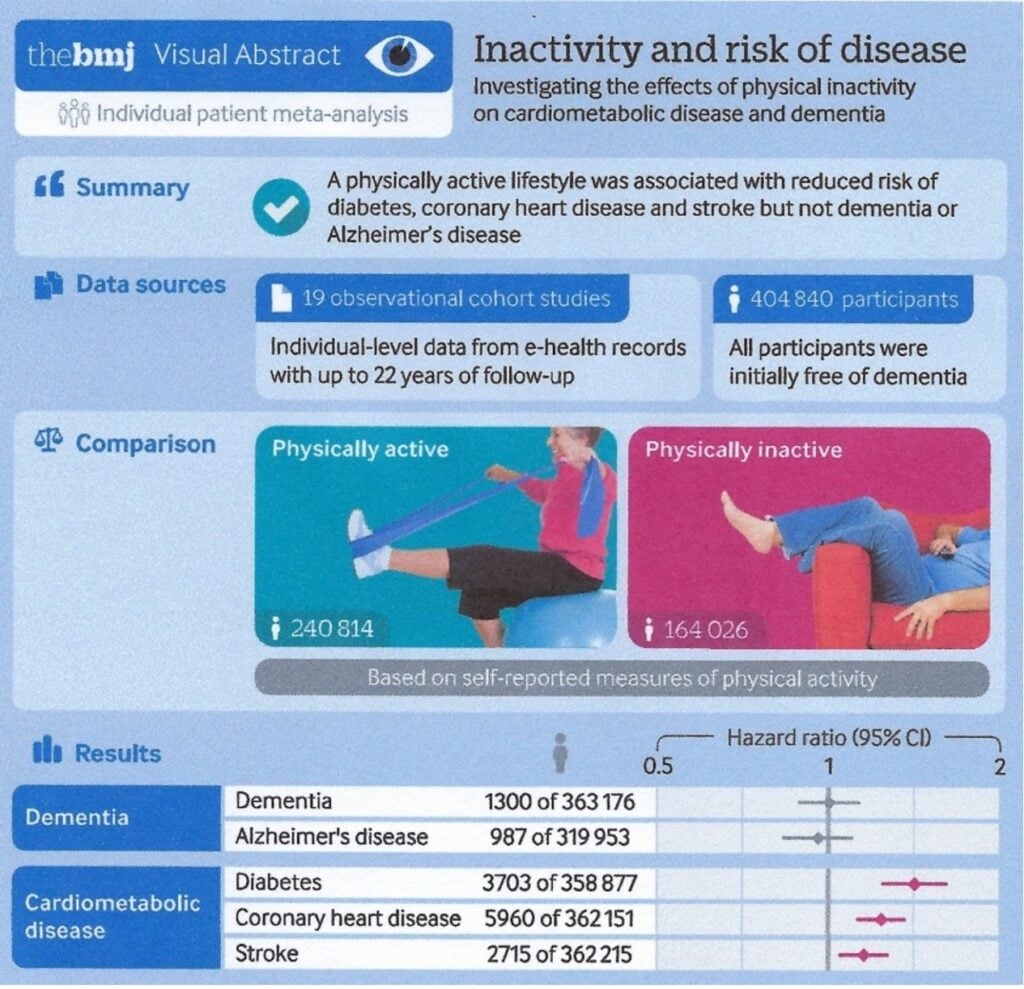
In a meta-analysis by Kivimäki et al. (2019), analyses that addressed bias due to reverse causation found no association between physical inactivity and all-cause dementia or Alzheimer’s disease. The study population comprised 404 840 people (mean age 45.5 years, 57.7% women) who were initially free of dementia, had a measurement of physical inactivity at study entry, and were linked to electronic health records. In these analyses, physical inactivity was not associated with all-cause dementia or Alzheimer’s disease, although a subgroup of physically inactive individuals who developed cardiometabolic disease showed an indication of excess dementia risk.
References
Bai, W., Chen, P., Cai, H., Zhang, Q., Su, Z., Cheung, T., Jackson, T., Sha, S., & Xiang, Y. T. (2022). World-wide prevalence of mild cognitive impairment among community dwellers aged 50 years and older: a meta-analysis and systematic review of epidemiology studies. Age and Ageing, 51(8). https://doi.org/10.1093/AGEING/AFAC173
Brennan, S. E., McDonald, S., Page, M. J., Reid, J., Ward, S., Forbes, A. B., & McKenzie, J. E. (2020). Long-term effects of alcohol consumption on cognitive function: a systematic review and dose-response analysis of evidence published between 2007 and 2018. Systematic Reviews, 9(1). https://doi.org/10.1186/S13643-019-1220-4
Cepeda-Pineda, D., Sequeda, G., Carrillo-Sierra, S. M., Silvera-Cruz, K., Redondo-Chamorro, J., Rozo-Sánchez, A., Bermúdez, V., Contreras-Velásquez, J. C., Gómez-Charris, Y., & Rivera-Porras, D. (2025). Clinical Effectiveness of Treatments for Mild Cognitive Impairment in Adults: A Systematic Review. European Journal of Investigation in Health, Psychology and Education, 15(11), 226. https://doi.org/10.3390/EJIHPE15110226
Chen, Y., Yin, X., Wang, X., Zheng, X., Yang, X., Zhou, J., Shi, M., & Zhang, Y. (2025). Associations of alcohol drinking with incident dementia: a prospective study from the UK Biobank. European Journal of Epidemiology. https://doi.org/10.1007/s10654-025-01304-y
Choi, H. Y., Kim, Y. J., Son, D. S., Ahn, M. E., & Lee, S. K. (2025). Effectiveness of a 52-week multidomain intervention to maintain cognitive function in patients with mild cognitive impairment: a randomized controlled trial. Scientific Reports, 15(1). https://doi.org/10.1038/S41598-025-24865-0
Choi, S., & Je, Y. (2026). Alcohol consumption and cognitive function: A systematic review and dose-response meta-analysis of 20 cohort studies. Addiction (Abingdon, England). https://doi.org/10.1111/ADD.70558
Cumming G. (2018) “Banning p values? The journal Political Analysis does it.” Posted on February 3, 2018, Categories NHST, The New Statistics.
DeCarli, C. (2003). Mild cognitive impairment: prevalence, prognosis, aetiology, and treatment. The Lancet Neurology, 2(1), 15–21. https://doi.org/10.1016/S1474-4422(03)00262-X
Livingston, G., Huntley, J., Liu, K. Y., Costafreda, S. G., Selbæk, G., Alladi, S., Ames, D., Banerjee, S., Burns, A., Brayne, C., Fox, N. C., Ferri, C. P., Gitlin, L. N., Howard, R., Kales, H. C., Kivimäki, M., Larson, E. B., Nakasujja, N., Rockwood, K., … & Mukadam, N. (2024). Dementia prevention, intervention, and care: 2024 report of the Lancet Standing Commission. The Lancet, 404(10452), 572–628. https://doi.org/10.1016/S0140-6736(24)01296-0
Kivimäki, M., Singh-Manoux, A., Pentti, J., Sabia, S., Nyberg, S.T., Alfredsson, L., Goldberg, M., Knutsson, A., Koskenvuo, M., Koskinen, A., Kouvonen, A., Nordin, M., Oksanen, T., Strandberg, T., Suominen, S.B., Theorell, T., Vahtera, J., Väänänen, A., Virtanen, M., Westerholm, P., Westerlund, H., Zins, M., Seshadri, S., Batty, G.D., Sipilä, P.N., Shipley, M.J., Lindbohm, J.V., Ferrie, J.E., Jokela, M.; & IPD-Work consortium (2019) Physical inactivity, cardiometabolic disease, and risk of dementia: an individual-participant meta-analysis. BMJ. 2019 Apr 17;365:l1495. https://doi.org/10.1136/bmj.l1495.
Ornish, D., Madison, C., Kivipelto, M., Kemp, C., McCulloch, C. E., Galasko, D., Artz, J., Rentz, D., Lin, J., Norman, K., Ornish, A., Tranter, S., DeLamarter, N., Wingers, N., Richling, C., Kaddurah-Daouk, R., Knight, R., McDonald, D., Patel, L., … & Arnold, S. E. (2024). Effects of intensive lifestyle changes on the progression of mild cognitive impairment or early dementia due to Alzheimer’s disease: a randomized, controlled clinical trial. Alzheimer’s Research & Therapy, 16(1). https://doi.org/10.1186/S13195-024-01482-Z
Rothman, K.J. (2014) Six persistent research misconceptions. Journal of General Internal Medicine, 29(7), 1060-1064. PMID: 24452418 https://doi.org/10.1007/s11606-013-2755-z
Sabia, S., Fayosse, A., Dumurgier, J., Dugravot, A., Akbaraly, T., Britton, A., Kivimäki, M., & Singh-Manoux, A. (2018) Alcohol consumption and risk of dementia: 23-year follow-up of Whitehall II cohort study. BMJ. 2018 Aug 1;362:k2927. https://doi.org/10.1136/bmj.k2927.
Sabia, S., Fayosse, A., Dumurgier, J., Dugravot, A., Akbaraly, T., Britton, A., Kivimäki, M., & Singh-Manoux, A. (2017) Physical activity, cognitive decline, and risk of dementia: 28 year follow-up of Whitehall II cohort study. BMJ 2017:357:j2709.
Salemme, S., Lombardo, F. L., Lacorte, E., Sciancalepore, F., Remoli, G., Bacigalupo, I., Piscopo, P., Zamboni, G., Rossini, P. M., Cappa, S. F., Perani, D., Spadin, P., Tagliavini, F., Vanacore, N., & Ancidoni, A. (2025). The prognosis of mild cognitive impairment: A systematic review and meta-analysis. Alzheimer’s & Dementia (Amsterdam, Netherlands), 17(1). https://doi.org/10.1002/DAD2.70074
Topiwala, A., Levey, D. F., Zhou, H., Deak, J. D., Adhikari, K., Ebmeier, K. P., Bell, S., Burgess, S., Nichols, T. E., Gaziano, M., Stein, M., & Gelernter, J. (2025). Alcohol use and risk of dementia in diverse populations: evidence from cohort, case-control and Mendelian randomisation approaches. BMJ Evidence-Based Medicine. https://doi.org/10.1136/bmjebm-2025-113913
Xu, Z., Sun, W., Zhang, D., Chung, V. C. H., Sit, R. W. S., & Wong, S. Y. S. (2021). Comparative Effectiveness of Interventions for Global Cognition in Patients With Mild Cognitive Impairment: A Systematic Review and Network Meta-Analysis of Randomized Controlled Trials. Frontiers in Aging Neuroscience, 13, 653340. https://doi.org/10.3389/FNAGI.2021.653340/TEXT
Zhang, R., Li, B., & Miao, Y. (2026). Alcohol consumption and risk of dementia: a systematic review and meta-analysis. Internal Medicine Journal, 56(5), 750–765. https://doi.org/10.1111/IMJ.70288
Comments on this critique by the International Scientific Forum on Alcohol Research were provided by the following members:
Henk Hendriks, PhD, Independent consultant and partner of the Nutrition Consultants Cooperative, Netherlands
Creina Stockley, PhD, MBA, Independent consultant and Adjunct Senior Lecturer in the School of Agriculture, Food and Wine at the University of Adelaide, Australia
R. Curtis Ellison, MD, Section of Preventive Medicine/Epidemiology, Boston University School of Med-icine, Boston, MA, USA
Richard Harding, PhD, Formerly Head of Consumer Choice, Food Standards and Special Projects Division, Food Standards Agency, UK
Racquel Romano, PhD, Independent consultant and Professor of Applied Technology at the University of Aconcagua, Argentina
Erik Skovenborg, MD, specialized in family medicine, member of the Scandinavian Medical Alcohol Board, Aarhus, Denmark
Full commentary provided by Forum member Romano on Choi and Je (2026)
“Choi et al. (2026) is methodologically rigorous as a systematic review, yet the strength of its conclusions is constrained by a central conceptual issue: it attempts to summarise, through a single dose–response relationship, a phenomenon—cognitive function—that is multidimensional, dynamic, and strongly multicausal.
A major strength of the study is its synthesis of 20 cohort studies comprising 78,657 participants and its use of random-effects models, dose–response modelling, tests for non-linearity, subgroup analyses, and sensitivity analyses. The review was also prospectively registered in PROSPERO and conducted in accordance with PRISMA recommendations. These features enhance transparency and methodological reproducibility.
Nevertheless, a meta-analysis increases the statistical precision of the available evidence but does not necessarily increase its causal validity. When the primary studies are observational and contain residual confounding, exposure misclassification, differences in outcome measurement, and selection biases, meta-analysis cannot eliminate these limitations. It may provide a statistically more precise estimate of an association that nevertheless remains methodologically biased. This distinction is essential when interpreting the findings of the present study.
Effectiveness and limits of the meta-analysis: This meta-analysis is effective for answering a relatively restricted epidemiological question: what average association is observed across published cohort studies between alcohol consumption and measures of cognitive function? It is considerably less effective for answering a causal question such as how much cognitive decline is caused by alcohol and at what precise dose such an effect begins.
This distinction matters because heterogeneity in the principal analysis was high (I² = 78.4% in the non-linear model). Although heterogeneity decreased in some subgroup analyses, it remained moderate to substantial. Accordingly, a fundamental conceptual question arises: to what extent does a single pooled dose–response curve retain biological meaning when it combines substantially different populations, exposure definitions, follow-up periods, and cognitive outcomes?
The included studies differed markedly in follow-up duration, geographic setting, alcohol-consumption categories, and cognitive assessment methods. The highest alcohol-consumption category varied substantially between studies. In addition, alcohol intake had to be standardised to grams per day, and when mean or median values were unavailable, midpoint values were used. For open-ended upper categories, the investigators assumed a category width equivalent to that of the adjacent category.
Thus, the statistical sophistication of restricted cubic spline modelling should not be equated with greater biological certainty. A model may be statistically advanced while remaining fundamentally limited by the comparability and validity of the underlying data.
Cognitive function as a multicausal and multidimensional outcome: One of the most important conceptual limitations concerns the nature of cognition itself. Cognitive function is not a single biological variable. It encompasses several partially distinct domains, including memory, attention, pro-cessing speed, executive function, language, and visuospatial abilities.
The study recognises this multidimensionality, yet when individual studies reported several cognitive domains, the meta-analysis selected a single estimate per study, prioritising global cognitive function, followed by attention/processing speed and memory. Although this approach reduces statistical dependence between multiple outcomes from the same cohort, it also compresses heterogeneous neuropsychological constructs into a simplified summary measure.
Moreover, cognitive performance is shaped by a complex network of determinants, including age, educational attainment and cognitive reserve, genetic susceptibility such as APOE genotype, cardio-vascular and metabolic disease, hypertension, diabetes, depression, smoking, physical activity, diet, social engagement, socioeconomic circumstances, medication use, and other psychoactive sub-stances. Alcohol exposure operates within this broader causal network rather than acting as an isolated determinant.
Although the included cohort studies adjusted for several covariates, adjustment was not uniform. The authors acknowledge that insufficient data prevented more detailed analyses by beverage type, ancestry, diet quality, APOE genotype, cardiometabolic disease, former-drinker status, and repeated assessments of alcohol intake. Consequently, residual confounding remains an important limitation.
From a conceptual perspective, alcohol should therefore be interpreted as one exposure within a complex causal system rather than as a single independent determinant of cognitive function. Statistical adjustment can reduce confounding for measured variables, but it cannot fully reconstruct the underlying causal structure.
Measurement of alcohol exposure: An additional limitation concerns how alcohol consumption was measured. In all included studies, alcohol intake was self-reported, and in most studies it was assessed at a single time point. This approach creates substantial potential for exposure misclassification and may not reflect long-term cumulative exposure.
This issue is particularly important in cognitive ageing. Alcohol intake measured at 60 or 70 years of age may not adequately represent drinking patterns over the preceding decades. Two individuals currently consuming 20 g/day may have substantially different exposure histories: one may have maintained that level for decades, whereas another may have recently reduced consumption after many years of heavier drinking.
Accordingly, grams per day estimates average current quantity rather than fully capturing neurobiological alcohol exposure. This metric does not adequately capture lifetime cumulative exposure, drinking pattern, episodic heavy drinking, periods of abstinence, changes over time, or necessarily beverage type. These dimensions may be highly relevant to neurocognitive outcomes.
Abstainers, former drinkers, and reverse causation: Choosing abstainers as the reference group creates another important interpretive challenge. Individuals developing cognitive impairment may reduce or discontinue alcohol consumption and subsequently be classified as abstainers. The authors recognise this potential source of reverse causation and report that only four included studies explicitly considered former drinkers.
This is highly relevant to the apparent inverted J-shaped curve. Better cognitive performance among light or moderate drinkers relative to non-drinkers cannot be interpreted as evidence of a neuroprotective effect of alcohol. Part of the observed difference may arise from reverse causation, the “sick-quitter” phenomenon, or systematic social, economic, nutritional, and health-related differences between moderate drinkers and abstainers.
Importantly, when baseline cognition was taken into account, the apparent cognitive advantage associated with low alcohol consumption was substantially attenuated, and the maximum positive standardised mean difference remained non-significant. This finding weakens any interpretation of a protective effect of low-to-moderate alcohol consumption.
Relationship between the results and the conclusions: A critical distinction must be made between a statistically permissible conclusion and a stronger clinical or causal interpretation. The overall analysis suggested a weak inverted J-shaped pattern, but the formal test for non-linearity did not reach conventional statistical significance (P = 0.061). Therefore, strictly speaking, the study does not provide statistically conclusive evidence for an overall non-linear J-shaped relationship.
Likewise, at low and moderate alcohol-consumption levels, confidence intervals generally included the null value. These findings do not demonstrate a protective cognitive effect of low-to-moderate drinking.
At higher levels of consumption, the analysis identified an inverse association between alcohol intake and cognitive function. However, even this result must be interpreted by distinguishing statistical significance from effect magnitude and causality. The observed effect size was relatively small and was derived from heterogeneous observational data.
The authors’ formal conclusion is, overall, appropriately cautious: they state that heavy alcohol consumption is associated with poorer cognitive function and that evidence for a protective effect of low-to-moderate intake remains uncertain. This conclusion is broadly consistent with the results as long as it is interpreted explicitly as an association rather than a causal effect.
Interpretive concerns in the Discussion: A more debatable aspect of the Discussion is the emphasis placed on an apparent threshold of approximately 28 g/day in studies that accounted for baseline cognition. The authors note that this level is close to some low-risk drinking guideline limits and use this observation to support a cautious interpretation of such recommendations.
However, 28 g/day should not be understood as an established neurotoxic threshold. It emerged from a subgroup comprising only nine studies and 23,385 participants, and substantial heterogeneity remained. More accurately, it represents the approximate point on the modelled dose–response curve at which the confidence interval in that subgroup no longer included the null value.
Accordingly, the study does not establish a biological boundary at 28 g/day. Interpreting this value as a precise causal threshold would exceed the strength of the available evidence.”
Proudly powered by WordPress. Theme by Infigo Software.