
Critique 304 – Moderate Wine Consumption, Defined by the Mediterranean Diet, Is Associated With Delayed Biological Aging in Men From the Moli-sani Study
Esposito, S., Di Castelnuovo, A., Costanzo, S., Gialluisi, A., Pepe, A., Ruggiero, E., De Curtis, A., Magnacca, S., Persichillo, M., Casanovas-Garriga, F., Cerletti, C., Donati, M.B., de Gaetano, G., Iacoviello, L., Bonaccio, M.
Int. J. Public Health (2026) 71:1609410. https://doi:10.3389/ijph.2026.1609410
Abstract
Background: To investigate the association between wine consumption and biological aging in the Moli-sani Study.
Methods: Dietary data were assessed using a 188-item FFQ. Participants (n = 22,495) were classified as abstainers, former drinkers, moderate drinkers according to national guidelines (≤250 mL/d men; ≤125 mL/d women) or Mediterranean Diet (MD) (125–500 mL/d men; 62.5–250 mL/d women), and heavy drinkers (>500 mL/d men; >250 mL/d women). Biological age (BA) was estimated with a deep neural network using 36 circulating biomarkers, and Δage (BA–chronological age) served as an index of biological aging.
Results: In men, wine consumption, at doses defined moderate by a current MD Score, was associated with slower biological aging (Δage β = −0.39; 95%CI: −0.78, −0.01 vs. abstainers). Dose–response analyses showed a J-shaped curve, with the slowest Δage at ~170 mL/d (Δage = −0.34 years; 95%CI: −0.66, −0.03). Overall ethanol intake, including all alcoholic beverages consumed, was neutral at moderate levels and associated with faster biological aging at higher doses.
Conclusions: Moderate wine consumption, but not overall ethanol intake, may contribute to slower biological aging in men.
ISFAR Summary
This innovative study offers an approach to capture the effects of lifestyle factors, such as wine consumption, on biological age. Biological age was computed using a supervised machine-learning algorithm, a Deep Neural Network, based on 36 biomarkers reflecting the body’s major physiological systems. The maximal overall difference between biological and chronological ageing was reported to be 6 years. Wine-consuming men (approximately 1.5–2 glasses per day) were approximately 0.4 years younger in biological age than non-drinkers. Although the study considered both the quantity and pattern of wine consumption, as well as other lifestyle factors such as diet, clinical conditions, and socio-demographics, the results were inconsistent with other observations. Further research using more biomarkers, however, may help identify the lifestyle factors important in biological ageing and support a healthy, long life.
Although Forum member de Gaetano is one of the authors of this paper, neither he nor any of his colleagues contributed to this Forum critique.
Background
Ageing is a biological process characterised by the progressive accumulation of molecular and cellular damage, resulting in a gradual decline in physical and mental capacity. The global population is ageing, and by the late 2070s, those aged 65 and older are projected to reach 2.2 billion, surpassing the number of children under 18[1].
Biological ageing is complex and varies between individuals, making it difficult to characterise. Several definitions and methods have been developed, including questionnaires such as the SF-36 (Ware & Gandek, 1998) and the Subjective Vitality Scales (Ryan & Frederick, 1997) developed in the 1990’s.
A WHO working group developed the concept of vitality (Bautmans et al., 2022) as an indicator of biological ageing, based primarily on biomarkers. However, this concept has varied across studies and has initially focused on nutrition and muscle strength, with limited validation (Chew et al., 2025). Recent evaluations of the ‘vitality/biological ageing’ concept indicate substantial variability in measurement tools, with most instruments assessing only one or two domains of vitality (Logvinov & Loerzel, 2026).
Over the last decades, genetic (a.o. telomere length) and epigenetic changes (a.o. DNA methylation) have been proposed as important drivers of the ageing process (Horvath & Horvath, 2013; López-Otín et al., 2023). These genetic and epigenetic changes lead to biological and metabolic alterations, which may be reflected in disease biomarkers.
Esposito et al. (2026) investigated the association between wine consumption and biological ageing in a Southern Italian population using a composite marker based on 36 circulating (blood-based) biomarkers. This approach is more comprehensive than single biomarkers, as it captures multiple physiological systems, including metabolic, cardiovascular, inflammatory, and renal pathways, thereby providing an integrated measure of whole-body physiology (Morelli et al., 2025; Tian et al., 2023; Zhang et al., 2022).
Biological age was computed using a supervised machine learning algorithm, called a Deep Neural Network (DNN) (Gialluisi et al., 2019; 2022). Using this approach, the authors found that moderate wine consumption, but not overall alcohol consumption, may contribute to slower biological ageing in men only.
Critique
The authors employ an innovative approach to examine associations between a lifestyle factor and the complex, multifactorial process of ageing. Specifically, they use artificial intelligence, a deep neural network (DNN), to estimate biological age from multiple biomarkers. While this approach is methodologically advanced, DNNs are inherently complex and function as a ‘black box,’ making it impossible to identify which variables drive the observed associations. As noted by the authors, both epidemiological analyses and DNN-derived estimates are based on associations and should not be interpreted causally. The model was trained on 80% of the dataset to minimise the mean squared error between chronological and predicted biological age. Performance metrics, including a Pearson correlation of 0.76 and a Nagelkerke’s R² of 0.57, indicate moderately good predictive accuracy, suggesting that the DNN explains a substantial proportion, but not all, of the variance. However, the resulting biological age measure may lack interpretability and depend on model assumptions and training data, thereby limiting transparency and generalisability. Moreover, different modelling choices or populations may yield varying biological age estimates, raising questions about reproducibility.
The maximal overall difference between biological and chronological ageing, expressed as Δage, was reported to be 6 years. Wine-consuming men (approximately 1.5–2 glasses per day) were approximately 0.4 years younger in biological age than non-drinkers, suggesting that moderate wine consumption may benefit biological ageing in men. Effect sizes, however, were often small and borderline. Also, the confidence intervals were often wide and sometimes crossed the null in fully adjusted models, making clinical significance uncertain.
However, the association between moderate wine consumption and Δage did not vary by adherence to the Mediterranean diet, which is notable given the Mediterranean diet’s impact on survival (Nucci et al., 2026). The authors indicate in their discussion that “a potential mechanism may involve polyphenols contained in wine, which are implicated in reducing inflammation, oxidative stress, and improving metabolic function, all mechanisms involved in ageing, and specifically reflected in our biological age measure”. The latter may be considered in contrast to the finding that adherence to the Mediterranean diet did not affect the outcome. Also, the authors suggest that polyphenols and their antioxidant and anti-inflammatory effects are reflected in their biological age measure, whereas the 36 biomarkers do not include any measure of antioxidant status and include only one inflammation marker. In addition, the use of restricted cubic splines allows modelling of non-linear associations, revealing a J-shaped relationship in which moderate wine consumption of approximately 170 mL/day for men was associated with the lowest biological ageing, providing a more nuanced analysis than simple drinker versus non-drinker comparisons.
In contrast, no differences in Δage were observed across wine consumption patterns in women, even though the Mediterranean diet is associated with reduced mortality in both men and women (Lopez-Garcia et al., 2014). The authors attribute sex differences in alcohol-related health effects to variations in metabolism and hormones. Although this may be true, it does not fully explain the moderate effects of wine consumption on biological ageing in men versus women, since overall survival effects are similar in men and women on a Mediterranean diet. Also, the authors use the term ‘biological ageing’ in their paper, whereas they reference a paper on brain ageing (Cole et al., 2018), which is confusing.
Overall, this study offers an innovative approach to capturing the effects of lifestyle factors, such as wine consumption, on biological age, by considering both the quantity and pattern of consumption and specifically whether consumption occurs at moderate levels, with meals, and as wine rather than other alcoholic beverages. The substantial data on lifestyle, diet, clinical conditions, and socio-demographics enabled extensive adjustment for confounders. Further research using epigenetic markers and refined blood-based biomarkers, however, may enhance the study of biological ageing. It may help identify the lifestyle factors important in biological ageing and help support a healthy, long life.
Specific Comments
Forum member Harding suggests that “a distinction is made in the paper between ‘moderate drinkers’ and ‘Mediterranean moderate drinkers’, the latter being moderate drinkers who also adhere to a Mediterranean diet. A Mediterranean diet is not defined in the paper, but it is in one of the references (#13, Trichopoulou et al. 2009). It is a diet characterised by a high intake of vegetables, fruits and nuts, legumes, fish and seafood, and cereals; low intake of meat and meat products and dairy products; high ratio of monounsaturated to saturated lipids; and moderate intake of ethanol.
Dietary intake for this cohort was assessed by the EPIC food frequency questionnaire, which had been ‘validated and adapted to the Italian population’ (#31, Pisani et al. 1997). The questionnaire was validated through subsequent 24-hour recall interviews conducted monthly for 12 months and urine collection every 2 months.
The Pisani paper is clear that the questionnaire was only successfully validated for alcohol consumption. For other dietary items, the agreement between the questionnaire and 24-hour recalls was poor. The discussion states, ‘inaccuracy in estimating the intake of some items was expected, although quantitatively unknown’, so this came as no surprise. The response to this finding was simply to add more questions to the questionnaire.
Finding out what people actually eat and drink is notoriously difficult, but the intakes recorded by these food-frequency questionnaires do seem very wide of the mark. For example, the mean meat consumption is 87g/day for men and 84g/day for women. A study of regional food consumption in Italy (Mattarello et al. 2024) used data from the Italian National Food Consumption Survey, in which participants recorded their food and drink consumption in a three-day diary. The results overall were summarised in this graph.
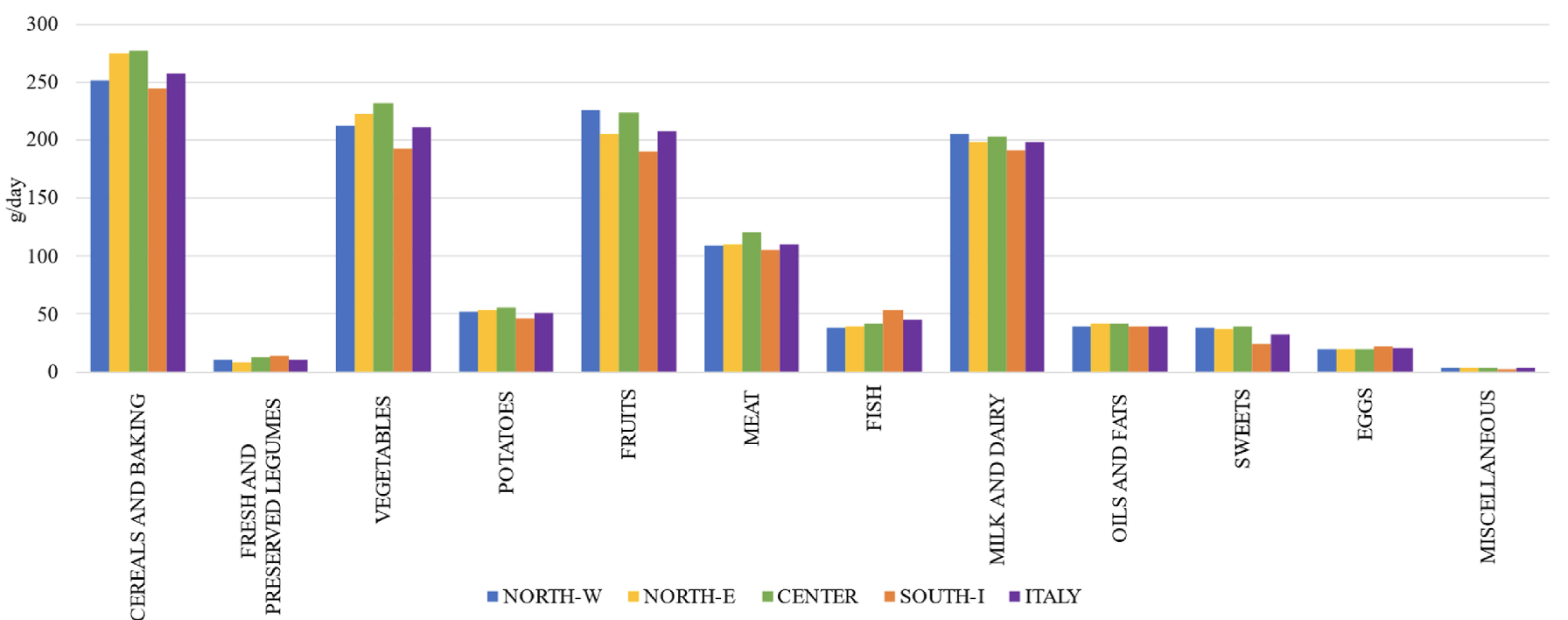
This indicates that there is little variation across Italy’s different regions. Meat consumption is recorded as about 125g/day. Milk and dairy consumption are high, and legume consumption is very low. This is a very long way from the Mediterranean diet as described above. Also, actual per capita meat consumption in Italy is 80.96kg/year (222g/day), while in Spain it is 100.26kg/year.
For these reasons, I don’t have confidence in the findings on dietary intake in this paper, except for alcohol consumption.
Forum member Ellison writes that “this paper makes me realise how much is new and innovative in approaches for evaluating health outcomes. As someone in his 90s, I have given up trying to understand in any depth the multitude of emerging scientific approaches to methodology being developed, but I found the opening critique by the Directors of our Forum very useful for gaining some insight into the approach used in this paper.
However, I am very pleased that scientists are beginning to view biological ageing as a better approach than simply using chronological age to assess the potential effects of wine consumption on health and longevity. I look forward to many more studies using this approach.
As for the results of these analyses, a few comments. As expected, the effects on biological ageing were not seen in the youngest group of subjects (and CVD is rare at this age), but primarily in older subjects. As the authors stated, the estimated effects of wine were relatively small. This could be because the actual effects are not large, or that the 36 biomarkers used to judge the extent of biological ageing did not provide an ideal assessment of this important outcome. It will be interesting to see the results of further studies that use a variety of measures for assessing biological ageing.
The authors’ Discussion postulated potential mechanisms for the lack of a demonstrated effect among women, but more extensive studies will be required to evaluate the observed differences. Further, the relationships with the separate components of the Med-Diet were interesting, as it has always been difficult to judge which of its many components are most important for their health effects. The results of these analyses suggest that, in addition to wine intake, higher vegetable and monounsaturated fat intake have greater effects on biological ageing than other dietary components. for example, in these results, the intake of milk and dairy products had essentially no effect, and there were fewer effects from the intake of cereals or fruits. Overall, the data support the advantages of the Med-Diet in terms of improving biological age.”
Forum member Skovenborg have a few observations. “It is interesting that the proportion of abstainers in this cohort of 24,325 individuals from the Molise region in the Central-Southern part of Italy was 30.4% while the number of former drinkers was 3.3%. With 44.7% moderate drinkers, the number of abstainers is almost the same, and that would make it plausible that the abstainers in most ways are “normal people”, which diminishes the problem of confounding factors stressed by authors like Stockwell et al. When I think of a typical Italian family, I imagine the parents eating pasta and drinking a few glasses of local wine with their meal. Is that just a romantic picture from the past? The number of that type of “Mediterranean moderate drinkers” was only 15.7% in the Molise cohort.
A J-shaped association was observed among healthy men, while no association was observed among healthy women. According to Supplementary Figure S3c, consumption of wine between 50 ml and 500 mL per day was associated with a non-significant increase in biological ageing. this is a very disturbing result that requires a plausible explanation, none of which has been suggested by the authors. Reference #40 reported a 27% lower alcohol elimination rate (AER) in women than in men, attributable to differences in lean body mass and liver size. However, that would not explain the curve in Figure S3c.
In the study, the inverse association between wine intake and biological ageing appeared stronger in middle-aged participants, suggesting “this may reflect age-related declines in liver function and alcohol-metabolising enzymes, which slow alcohol processing.” However, reference #40 found no age-related impairment of AER, and reference #42 is a flawed study. In fact, liver function and AER are robust and not affected by age, as confirmed in many studies.”
Forum member Ursini states that this study by Esposito et al. (2026) investigates the relationship between wine intake and biological aging within a large Italian cohort of 22,495 participants. The research emerges during a period of intense global debate regarding alcohol consumption. While traditional Mediterranean Diet guidelines have long considered moderate wine consumption a component of a healthy lifestyle, more recent international public health perspectives, particularly those promoted by the WHO, increasingly argue that no level of alcohol consumption can be considered entirely risk-free.
Within this context, the study identifies a distinct J-shaped relationship between wine consumption and biological ageing in men. Slower biological ageing was observed among men consuming between 125 and 500 mL of wine per day, with the greatest apparent benefit occurring at approximately 170 mL daily. Importantly, this association appeared specific to wine consumption, as high total ethanol intake derived from beer or spirits was instead associated with accelerated biological ageing. The study also reported a notable gender divergence, with no significant association observed in women. The authors suggest that this discrepancy may reflect physiological differences between sexes or lower variability in alcohol consumption patterns among women in the cohort.
A major innovation of the study lies in its use of Biological Age rather than chronological age as the primary outcome measure. Biological age was calculated using a Deep Neural Network trained on 36 circulating biomarkers, including indicators of renal function, such as creatinine and albumin, markers of glucose metabolism, and inflammatory markers, including C-reactive protein. This approach provides a more comprehensive physiological assessment than analyses relying on a single biomarker. Deep learning methods are particularly suited to modelling the complex and non-linear interactions that characterise biological systems. Nevertheless, the use of a Deep Neural Network also introduces limitations associated with the so-called “black box” problem. Although the model suggests that moderate wine consumers appear biologically younger, it does not clearly identify which physiological pathways may be responsible for this association. It therefore remains uncertain whether the observed effect is primarily related to cardiovascular function, systemic inflammation, metabolic efficiency, or other mechanisms. Additional minor limitations arise from the specificity of the cohort itself. The model was trained exclusively on the Moli-sani population, meaning that the biological ageing signatures identified may be influenced by Mediterranean dietary habits, environmental exposures, and genetic background. As a result, the findings may not be directly generalizable to populations with substantially different lifestyles or genetic profiles. Furthermore, despite the sophistication of the machine learning approach, the study remains observational in nature and therefore cannot establish causality. The possibility of healthy user bias cannot be excluded, as individuals who consume wine moderately within a Mediterranean lifestyle may also engage in other beneficial health behaviours that were not fully measured or controlled for.
Overall, the work by Esposito et al. (2026) contributes an important and technologically sophisticated perspective to the longstanding discussion surrounding the “French Paradox” and the health effects of moderate wine consumption. By applying machine learning techniques to the study of biological ageing, the research suggests that moderate wine intake within the context of a Mediterranean dietary pattern may be associated with preservation of physiological function in men. However, the absence of clear mechanistic explanations within the Deep Neural Network model, together with the neutral findings observed in women, indicates that the results should be interpreted cautiously.“
Forum member Romano shares that “the study by Esposito et al. (2026) attempts to demonstrate that moderate wine consumption within the context of the Mediterranean diet is associated with slower biological ageing in Italian men. Although the study includes a large sample size and employs a sophisticated artificial intelligence model based on circulating blood biomarkers, its conclusions should be interpreted with considerable caution due to several methodological and conceptual limitations.
First, the study design is observational and cross-sectional, which precludes establishing causality. Although the authors acknowledge this limitation, they nevertheless formulate biological interpretations suggesting that wine consumption has protective effects. In reality, the study only identifies weak statistical associations. The main finding corresponded to approximately −0.39 years of biological age among moderate wine consumers compared with abstainers, an extremely small effect with questionable clinical relevance. Furthermore, several confidence intervals approached the null value, indicating statistical instability.
Another important concern is the potential “healthy user bias.” Moderate wine drinkers within the Mediterranean dietary pattern also showed healthier overall characteristics, including lower body mass index, higher physical activity, better socioeconomic status, and healthier dietary habits. Although the authors adjusted for multiple variables, statistical adjustment can never fully eliminate residual confounding. Consequently, the apparent protective effect may simply reflect a generally healthier lifestyle rather than wine consumption itself.
In addition, the study relied on food frequency questionnaires (FFQs), a methodology well known for introducing recall bias and underreporting, particularly regarding alcohol intake. Actual drinking behaviours, such as binge drinking or weekly variability in alcohol consumption, were not adequately captured. This limitation is critical because alcohol-related toxicity depends not only on average intake but also on the pattern of consumption.
A further conceptual weakness is that the authors attribute potential benefits to wine polyphenols, yet do not measure specific polyphenol biomarkers or directly assess biological mechanisms. Therefore, the proposed mechanistic explanation remains speculative. Moreover, the study itself showed that total ethanol intake was not consistently associated with beneficial effects on biological ageing, partially contradicting the central hypothesis.
The article also minimises contemporary epidemiological evidence questioning the existence of safe levels of alcohol consumption. The World Health Organization explicitly states that no level of alcohol consumption can be considered completely safe. Nevertheless, the authors continue to support the classical “J-shaped curve” paradigm, which has long been criticised because of selection bias, the inclusion of former drinkers with preexisting illness among abstainers, and socioeconomic confounding.
Nevertheless, the study also presents important strengths. The analysed cohort was large and well characterised, comprising more than 22,000 participants, and the authors employed an innovative approach to estimate biological age using deep neural networks and 36 circulating biomarkers, thereby providing a modern, multidimensional methodological framework. In addition, the analyses considered numerous confounding factors and distinguished between wine and total ethanol intake, an uncommon feature in alcohol epidemiology research. These characteristics make the study a relevant contribution for generating new hypotheses regarding biological ageing and Mediterranean dietary patterns.
Finally, the external validity of the findings remains limited. The cohort consisted of adults from Southern Italy with specific cultural, dietary, and genetic characteristics. Therefore, extrapolation of these findings to other populations is methodologically questionable.
In conclusion, the study provides an interesting observation regarding associations between wine consumption and biomarkers of biological ageing; however, it does not demonstrate that wine delays biological ageing. The observed effects are small, potentially confounded by lifestyle factors, and based on self-reported data. Consequently, the conclusions should be interpreted as exploratory hypotheses rather than sufficient evidence to recommend alcohol consumption for health purposes.”
Forum member Waterhouse muses that “after reading my colleagues’ comments, I see we have many, though different, concerns about the limitations of the study. I am concerned that we do not have a consensus on this report.
My personal observation is that they created a biological ageing model and then applied it to wine consumption. I would like to see the new biological ageing model vetted in some way before it is used to evaluate the impact of a dietary factor. For instance, does the model predict observable fitness, morbidity, or longevity? I agree with Forum member Ellison that this is an exciting new development that could provide new insights into health, but it seems premature to say that it provides new evidence that wine consumption is “healthy”. “
References
Bautmans, I., Knoop, V., Amuthavalli Thiyagarajan, J., Maier, A. B., Beard, J. R., Freiberger, E., Belsky, D., Aubertin-Leheudre, M., Mikton, C., Cesari, M., Sumi, Y., Diaz, T., & Banerjee, A. (2022). WHO working definition of vitality capacity for healthy longevity monitoring. The Lancet Healthy Longevity, 3(11), e789–e796. https://doi.org/10.1016/S2666-7568(22)00200-8
Chew, J., Lee, J., Hernandez, H. H. C., Munro, Y. L., Lim, C. L., & Lim, W. S. (2025). The vitality domain of intrinsic capacity: A scoping review of conceptual frameworks and measurements. The Journal of Frailty & Aging, 14(4), 100058. https://doi.org/10.1016/J.TJFA.2025.100058
Cole, J. H., Ritchie, S. J., Bastin, M. E., Valdés Hernández, M. C., Muñoz Maniega, S., Royle, N., Corley, J., Pattie, A., Harris, S. E., Zhang, Q., Wray, N. R., Redmond, P., Marioni, R. E., Starr, J. M., Cox, S. R., Wardlaw, J. M., Sharp, D. J., & Deary, I. J. (2018). Brain age predicts mortality. Molecular Psychiatry, 23(5), 1385–1392. https://doi.org/10.1038/MP.2017.62
Esposito, S., Di Castelnuovo, A., Costanzo, S., Gialluisi, A., Pepe, A., Ruggiero, E., De Curtis, A., Magnacca, S., Persichillo, M., Casanovas-Garriga, F., Cerletti, C., Donati, M. B., de Gaetano, G., Iacoviello, L., & Bonaccio, M. (2026). Moderate wine consumption, defined by the Mediterranean diet, is associated with delayed biological aging in men from the Moli-sani Study. International Journal of Public Health, 71. https://doi.org/10.3389/IJPH.2026.1609410
Gialluisi, A., Di Castelnuovo, A., Costanzo, S., Bonaccio, M., Persichillo, M., Magnacca, S., De Curtis, A., Cerletti, C., Donati, M. B., de Gaetano, G., Capobianco, E., & Iacoviello, L. (2022). Exploring domains, clinical implications and environmental associations of a deep learning marker of biological ageing. European Journal of Epidemiology, 37(1), 35–48. https://doi.org/10.1007/S10654-021-00797-7
Gialluisi, A., Di Castelnuovo, A., Donati, M. B., de Gaetano, G., & Iacoviello, L. (2019). Machine Learning Approaches for the Estimation of Biological Aging: The Road Ahead for Population Studies. Frontiers in Medicine, 6. https://doi.org/10.3389/FMED.2019.00146
Horvath, H., & Horvath, S. (2013). DNA methylation age of human tissues and cell types. Genome Biology 2013 14:10, 14(10), 3156-. https://doi.org/10.1186/GB-2013-14-10-R115
Logvinov, I. I., & Loerzel, V. (2026). Vitality in older adults: A state-of-the-science review. Archives of Gerontology and Geriatrics, 141. https://doi.org/10.1016/j.archger.2025.106072
Lopez-Garcia, E., Rodriguez-Artalejo, F., Li, T. Y., Fung, T. T., Li, S., Willett, W. C., Rimm, E. B., & Hu, F. B. (2014). The mediterranean-style dietary pattern and mortality among men and women with cardiovascular disease. American Journal of Clinical Nutrition, 99(1), 172–180. https://doi.org/10.3945/ajcn.113.068106
López-Otín, C., Blasco, M. A., Partridge, L., Serrano, M., & Kroemer, G. (2023). Hallmarks of aging: An expanding universe. Cell, 186(2), 243–278. https://doi.org/10.1016/J.CELL.2022.11.001
Mattarello, G., Arfelli, F., Cespi, D., Passarini, F. & Vassura, I. (2024). Regional food consumption in Italy, a life cycle analysis. Environmental Research, 262(Pt 1):119867. https://doi.org/10.1016/j.envres.2024.119867.
Morelli, M., Pepe, A., Costanzo, S., Panzera, T., Magnacca, S., De Curtis, A., Venegas, M. L. M., Cerletti, C., Donati, M. B., de Gaetano, G., Iacoviello, L., & Gialluisi, A. (2025). Exploring the complex relationship between biological aging and cancer in a Prospective Italian Population Cohort. Aging and Disease, 17(3). https://doi.org/10.14336/AD.2025.0204
Nucci, D., Ragusa, F. S., Mazza, E., Veronese, N., Gianfredi, V., Volpe, M., Maggi, S., Onder, G., Sieber, C., Zanetti, M., Silano, M., Chernykh, A., Lorenzo, F. Di, Romiti, G. F., Schirò, P., Ungar, A., Maggi, S., Volpe, M., Zanetti, M., … Sieber, C. (2026). Adherence to the Mediterranean diet and all-cause mortality: A systematic review and meta-analysis within the Italian National Guidelines “La Dieta Mediterranea.” Nutrition (Burbank, Los Angeles County, Calif.), 147, 113189. https://doi.org/10.1016/J.NUT.2026.113189
Ryan, R. M., & Frederick, C. (1997). On energy, personality, and health: subjective vitality as a dynamic reflection of well-being. Journal of Personality, 65(3), 529–565. https://doi.org/10.1111/J.1467-6494.1997.TB00326.X
Tian, Y. E., Cropley, V., Maier, A. B., Lautenschlager, N. T., Breakspear, M., & Zalesky, A. (2023). Heterogeneous aging across multiple organ systems and prediction of chronic disease and mortality. Nature Medicine, 29(5), 1221–1231. https://doi.org/10.1038/S41591-023-02296-6
Ware, J. E., & Gandek, B. (1998). Overview of the SF-36 Health Survey and the International Quality of Life Assessment (IQOLA) Project. Journal of Clinical Epidemiology, 51(11), 903–912. https://doi.org/10.1016/S0895-4356(98)00081-X
Zhang, D., Leeuwenburgh, C., Zhou, D., Gong, Y., Pahor, M., Licht, J. D., & Braithwaite, D. (2022). Analysis of Biological Aging and Risks of All-Cause and Cardiovascular Disease-Specific Death in Cancer Survivors. JAMA Network Open, 5(6), E2218183. https://doi.org/10.1001/JAMANETWORKOPEN.2022.18183
Comments on this critique by the International Scientific Forum on Alcohol Research were provided by the following members:
Henk Hendriks, PhD, Independent consultant and partner of the Nutrition Consultants Cooperative, Netherlands
Creina Stockley, PhD, MBA, Independent consultant and Adjunct Senior Lecturer in the School of Agriculture, Food and Wine at the University of Adelaide, Australia
Richard Harding, PhD, Formerly Head of Consumer Choice, Food Standards and Special Projects Division, Food Standards Agency, UK
R. Curtis Ellison, MD, Section of Preventive Medicine/Epidemiology, Boston University School of Medicine, Boston, MA, USA
Erik Skovenborg, MD, specialised in family medicine, member of the Scandinavian Medical Alcohol Board, Aarhus, Denmark
Fulvio Ursini, MD, Emeritus Professor of Biochemistry, University of Padova, Padova, Italy
Raquel Romano, PhD, Independent consultant and Professor of Applied Technology at the University of Aconcagua, Argentina
Andrew L. Waterhouse, PhD, Professor Emeritus of Enology, Department of Viticulture and Enology, University of California, Davis, CA, USA
[1] United Nations, Department of Economic and Social Affairs, Population Division (2024). World Population Prospects 2024: Ten Key Messages.
Proudly powered by WordPress. Theme by Infigo Software.